

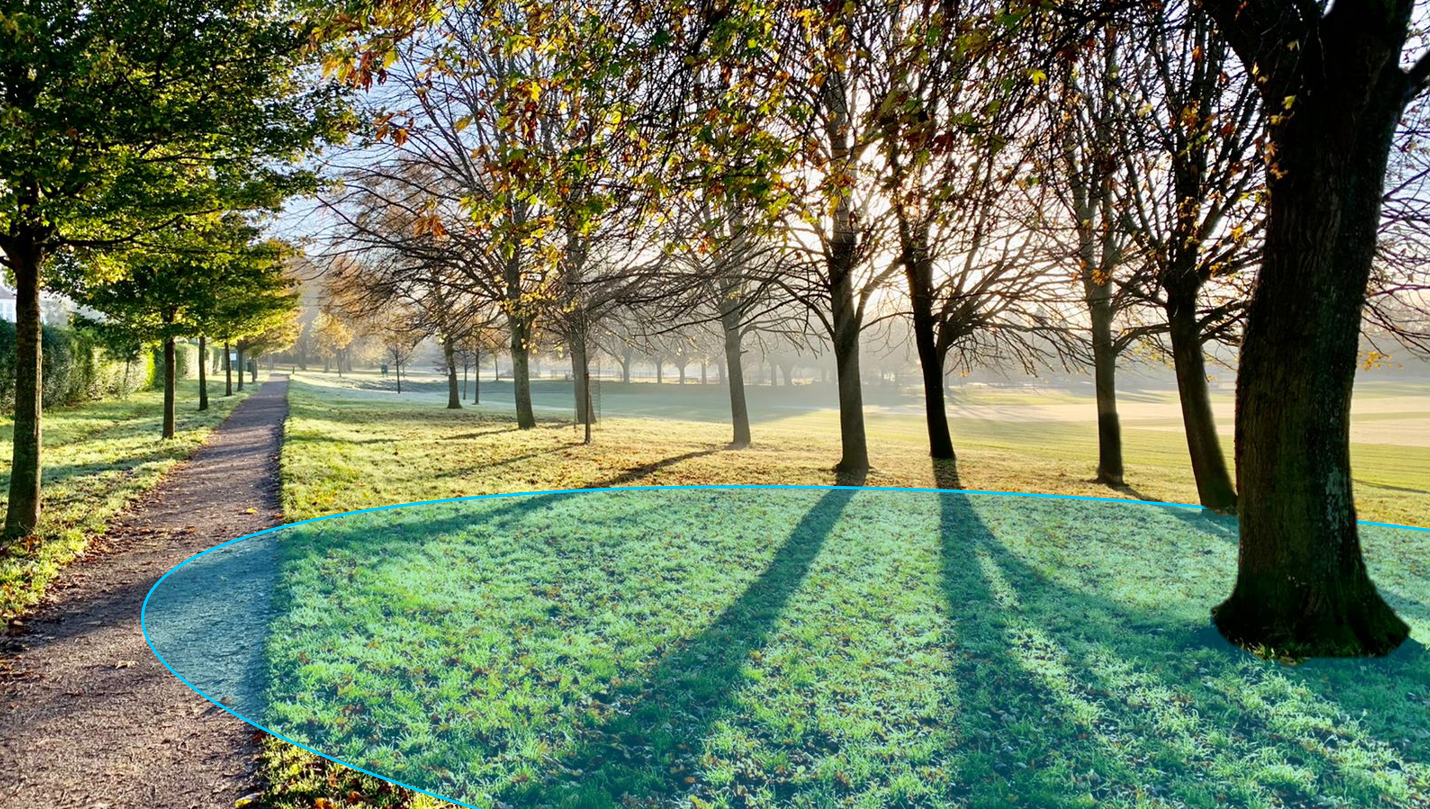
Understanding
Root Protection Areas
Everything you need to know — whether you're a homeowner curious about that oak at the bottom of the garden, or a developer navigating a complex planning consent.
There's a reason planning applications involving trees take longer, cost more, and generate more back-and-forth with the Local Planning Authority than almost any other issue. Trees aren't just aesthetically pleasing; they're legally protected assets, ecological habitats, and long-term carbon stores — and they are, frankly, easy to kill by accident if you don't know what you're doing.
The good news: with the right expertise involved early, trees and buildings coexist remarkably well. The Root Protection Area (RPA) is the key concept that governs how that relationship is managed during construction. This guide explains what it is, how it's calculated, what can damage a tree during a build (there's more than most people realise), and what solutions exist — many of which won't be obvious unless you've spent years working in this field.
What is a Root Protection Area?
An RPA is a layout design tool — a defined zone around a tree that represents the minimum area required to protect its roots and the soil structure around them. It isn't an arbitrary buffer: it's a mathematically derived area calculated to reflect the actual extent of a tree's root system relative to its size and species.
The standard governing this in the UK is BS 5837:2012 — Trees in relation to design, demolition and construction. Any arboricultural assessment worth submitting to a planning authority will be structured around it.
Fine, non-woody roots — the ones responsible for water and nutrient uptake — are typically concentrated within the top 600mm of the soil. This makes them extraordinarily vulnerable to even shallow surface works: a gravel path, a new drain run, or a few passes of a mini-digger can cause damage that only becomes visible years later, when the tree begins to decline.
RPA radius = 12× the stem diameter, measured at 1.5m height. Expressed as a circle on plan.
A combined stem diameter is calculated using a specific formula, ensuring the protection area reflects the full canopy mass.
The RPA is capped at 707m² for very large trees, but extended buffers are often applied in practice — and rightly so.
Want to calculate the RPA for your tree? Use our free RPA calculator tool to get an instant figure based on your stem measurements.
Try the RPA calculatorWhy the RPA matters for your project
The default position for most councils is simple: no structures, no excavations, no materials storage within the RPA. But the reason this matters isn't just bureaucratic. A specimen tree that has taken 80 years to reach maturity can be effectively killed by a single day of poor site management. And tree death rarely happens overnight — it can take three to five years before visible symptoms appear, by which point there is no remedy.
More practically: if a planning application involves trees and there is no arboricultural input, refusal becomes very likely. Tree Officers at Local Planning Authorities are increasingly sophisticated, and a generic statement about "protecting the tree" will not be sufficient. What they need is technical certainty — a demonstrable methodology, provided by a qualified professional, showing how the tree will survive the works.
Planning implications beyond the RPA itself: Trees affect planning in ways that go well beyond their root zones. Shade cast by existing or proposed trees, the amenity value of retained specimens, and root conflicts with adjacent trees can all influence what a planning authority will permit — even for development that sits entirely outside the RPA on plan.
How trees are damaged during construction — the full picture
Most guides focus on the obvious threats. The reality is considerably broader. Understanding the range of potential damage vectors is what separates a reactive approach from a genuinely protective one.
Heavy machinery crushes the air pockets that roots need to breathe. Even foot traffic over wet ground in winter can cause meaningful compaction across a season.
Cement mixing, fuel storage, paint washings, and concrete leachate can all alter soil pH to lethal levels. The damage is invisible until the tree declines.
Both cutting and filling are damaging. Lowering the ground by even 150mm can sever enough roots to fatally destabilise a tree. Raising levels smothers the root system.
New drainage, gas pipes, electricity cables and telecoms are among the most common sources of root severance on real sites. Routes need careful planning — or trenchless installation.
Replacing a permeable surface with impermeable hardstanding within the RPA — even without excavation — can fundamentally alter water and gas exchange that roots depend on.
New buildings that cast sustained shadow on established trees, or dense planting that competes for root space, can cause gradual long-term decline.
Changed drainage patterns or enclosed spaces where leaf matter accumulates against stems can promote fungal disease and collar rot over time.
Deep excavations outside the RPA but within the root influence zone can act as a drainage sump, pulling moisture away even when the tree itself is untouched.
Machinery passing close to a trunk can strip bark, creating entry points for disease. Overhead works — scaffolding, crane paths — need to account for crown clearance.
The Construction Exclusion Zone
The RPA provides the theoretical protection area. The Construction Exclusion Zone (CEZ) translates it into a physical reality on site — typically Heras fencing or timber barriers installed at or beyond the RPA boundary before any works begin, and maintained for the duration of the project.
Critically, the CEZ is not just a fence. It needs to be specified in the method statement, communicated to all contractors, and monitored throughout. An arboricultural watching brief is standard practice on higher-risk schemes.
When work inside the RPA is unavoidable — the solutions
Most planning applications involving trees require some degree of work within or close to the RPA. The question isn't whether to engage with the root zone at all, but how to do so responsibly. The solutions available are far more varied than most people — including many architects and developers — realise. Use our RPA calculator to understand the scale of your constraint before exploring which approach is right for your site.
- No-dig cellular systems for driveways and car parks that allow water and gas exchange beneath the surface
- Screw-pile and suspended beam foundations that bridge over the root zone entirely
- "Top-down, pull-back" demolition keeping machinery within the existing building footprint
- Directional drilling for service runs — gas, water, drainage — avoiding trenches through the root zone
- Permeable paving systems where some hardstanding within the RPA is genuinely unavoidable
- Structural soils and engineered root paths providing both loadbearing capacity and growing medium
- Impermeable liners when concrete pours near the RPA are unavoidable, preventing alkaline leachate
- Air-spading for non-destructive root mapping before committing to a layout
- Root barrier systems that redirect root growth away from sensitive structures without harming the tree
- Bespoke drainage designs that account for the tree's water requirements as well as the building's
- Phased construction sequences designed around the tree's physiological calendar
- Soil decompaction and amelioration works where existing ground conditions are already compromised
Trees off your site — still your problem
This is a question that catches many applicants off guard. Trees on neighbouring land, on the highway, or in the public realm can be material planning considerations. If your proposed development would encroach on the root zone of an off-site tree, affect its crown, or rely on its removal to proceed, this needs to be addressed in the application.
Similarly, a tree with a Tree Preservation Order (TPO) or within a Conservation Area may require separate consent for even minor works — pruning, root investigation — that might otherwise seem entirely routine.
Getting the process right from the start
The most common mistake is treating arboricultural input as something to commission once the design is already set. By that point, you may have already designed yourself into a conflict — either with the trees or with the planning authority.
Involving an arboriculturist at the earliest possible stage — ideally before any architect's drawings are produced — means the tree constraints inform the design, rather than being retrofitted around it at greater cost later.
Every site is different
The principles above are a starting point. How they apply to your specific trees, your specific site, and your specific planning authority is where the expertise lies. We're happy to talk through what your project might involve before you commit to anything.
Get in touch